


IBM webMethods delivers a significant return on investment, as per Forrester's study.

Businesses report a 40% drop in downtime by using this integration platform.

Reduce time for complex integration projects from 3 months to 2 months.

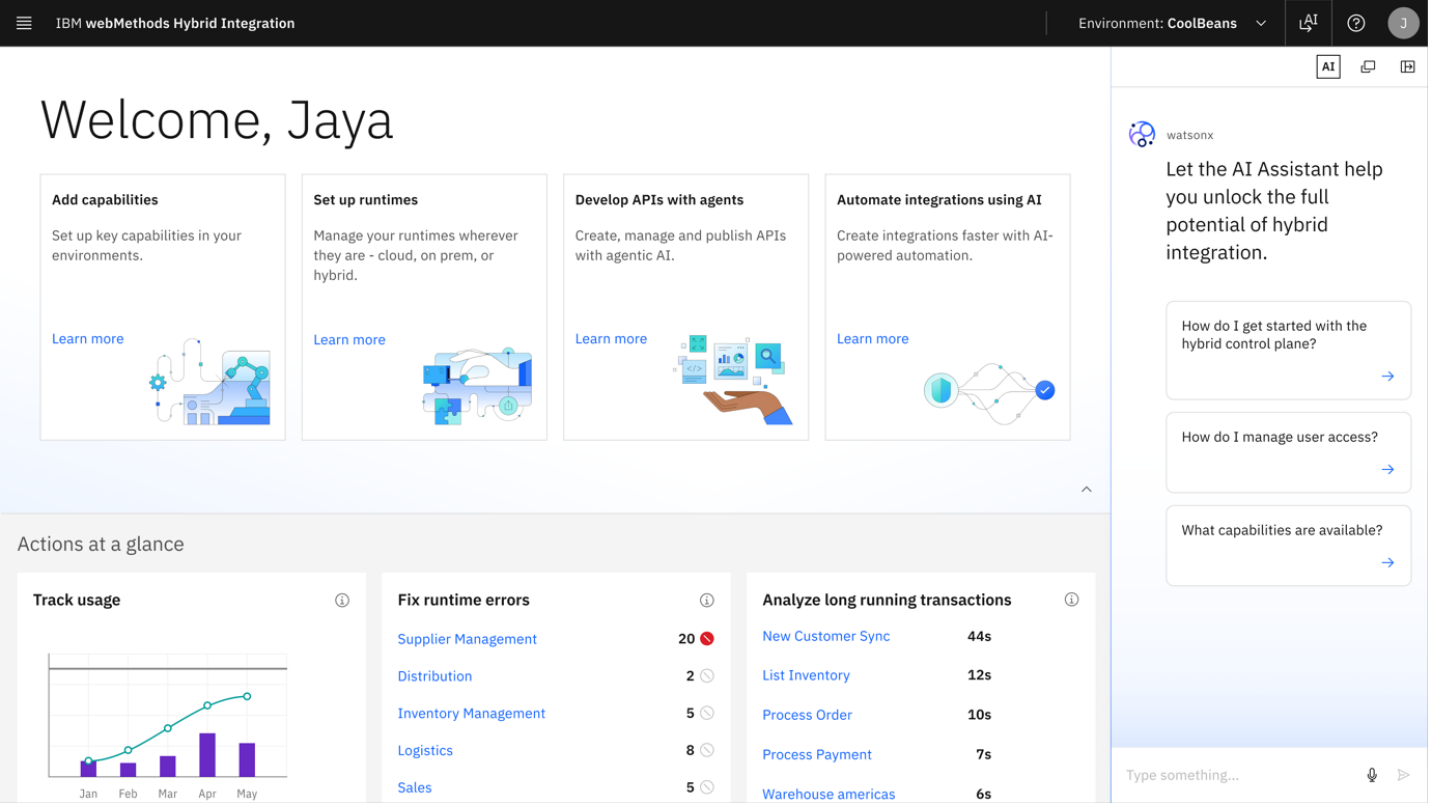
Integrates applications quickly and securely across hybrid environments.

Scalable API integration, monitoring, and management across multiple systems.

Automate secure business-to-business transactions efficiently.

Transfer data securely and quickly with cloud-based solutions.
Automatically respond to events with integrated actions across platforms.

Leverage AI to guide automation tasks and optimize processes.
Connects apps, APIs, and events across diverse environments.
Experience fast, tangible benefits in integration and productivity.

Deployed across over 1,000 organizations in various industries worldwide.

Streamlining Pharmaceutical Logistics with IBM Enterprise Application Integration
A leading pharmaceutical logistics provider enhanced operational efficiency and supply chain visibility by implementing IBM Enterprise Application Integration. The solution enabled secure, scalable data exchange across warehouse systems and customer platforms, improving shipment validation, compliance, and climate-neutral delivery operations.
Business challenge
The logistics provider manages high-volume pharmaceutical storage and distribution for multiple manufacturers and healthcare partners. However, legacy integration tools and siloed systems limited data transparency, caused manual errors, and slowed order fulfillment.
The company sought to:
- Overcome legacy system limitations for warehouse and transport coordination.
- Standardize data exchange between customer and partner systems.
- Improve delivery accuracy and compliance validation.
- Enable scalability to handle increasing shipment volumes and product complexity.
Solution
Working with IBM, the organization deployed IBM Enterprise Application Integration and IBM webMethods Integration to unify its digital infrastructure. The implementation enabled end-to-end connectivity between warehouse systems, logistics operations, and customer databases, ensuring reliable and secure data synchronization.
Solution Highlights:
- Real-time data exchange between internal and partner systems.
- Automated validation of shipping information and order status.
- Centralized integration platform supporting new business applications.
Streamlined transition from legacy architecture to a modern hybrid integration environment.
Solution components
- IBM Enterprise Application Integration
- IBM webMethods Integration
- IBM MQ
- IBM App Connect
Unified Integration Framework
Enabled consistent data flow between multiple customer systems, improving order accuracy and transparency.
Secure and Scalable Operations
Enhanced compliance and system security while ensuring readiness for growing client demands.
Faster Implementation Cycle
Reduced integration time and error rates by 7%, supporting faster deployment of logistics solutions.
Result
- 7% faster implementation time and reduced system errors.
- 8,000+ daily delivery line items processed with real-time data validation.
- Enhanced warehouse efficiency through unified system communication.
- Improved visibility into logistics performance and client satisfaction.
- Strengthened compliance management across pharmaceutical operations.
IBM Integration technology forms the backbone of our operations — it ensures the accuracy, validation, and availability of our pharmaceutical data. With this system, we have achieved greater transparency and reliability in serving our healthcare clients.
— Head of Logistics Systems, Leading Pharmaceutical Distribution Company

Driving Agility and Resilience in Financial Services with IBM webMethods
A leading insurance and financial services provider modernized its legacy systems and achieved operational resilience with IBM webMethods Hybrid Integration. The solution bridged the gap between decades-old infrastructure and next-generation digital platforms, enabling the organization to navigate regulatory challenges, accelerate product delivery, and achieve over 20% system availability improvement.
Business challenge
Operating in a highly regulated and competitive market, the company faced multiple pressures — legacy infrastructure, evolving compliance requirements, and prolonged periods of low interest rates. These challenges hindered agility and operational efficiency across its insurance, investment, and asset management divisions.
The enterprise needed a modern integration framework that could:
- Unify over 20+ critical business applications.
- Improve system reliability and performance.
- Accelerate digital transformation while maintaining compliance.
- Enable faster response to partner and customer requirements.
Solution
Partnering with IBM, the organization implemented IBM webMethods Hybrid Integration, creating a robust integration foundation capable of connecting internal and external systems. The platform allowed the company to automate workflows, ensure data accuracy, and achieve near real-time response to policy and regulatory changes.
Core Solution Highlights:
- Integration of 21+ enterprise systems through a unified data layer.
- Zero-downtime operations across multiple business lines.
- Improved compliance automation and faster deployment of new products.
- Hybrid deployment flexibility for scalability and performance.
Solution components
- IBM webMethods Hybrid Integration
- IBM Cloud Pak® for Integration
- IBM API Connect®
- IBM MQ®
Modernized Core Systems
Enabled seamless integration between legacy platforms and digital services without disrupting ongoing operations.
Regulatory Agility
Automated compliance processes, allowing faster adaptation to policy updates and government regulations.
Enhanced Business Continuity
Delivered a 20.5% improvement in system availability, ensuring uninterrupted customer and partner transactions.
Result
- 21+ applications integrated into a unified operational framework.
- Improved system uptime and performance across critical systems.
- Zero downtime during modernization rollout.
- Accelerated innovation cycles and faster product time-to-market.
- Strengthened the company’s resilience in a volatile economic landscape.
IBM webMethods gives us the long-term stability to outperform our competitors, even in challenging times. The platform allows us to respond rapidly to partner needs, customer demands, and regulatory changes — no other solution offers such comprehensive integration capabilities.
— Chief Technology Officer, Leading Insurance and Financial Services Provider

“WebMethods helped us integrate critical systems faster, enhancing our operations with seamless API connections.”
Komatsu
“IBM webMethods streamlined our processes and improved real-time decision-making, ultimately enhancing our ability to scale effectively.”
Carnival Cruise Line